
Children with Down’s syndrome develop their motor skills at different rates, and this can be for many reasons. However, many will benefit from support that targets some key areas and far from being onerous, most activities will have an element of family-friendly fun.
Children with Down’s syndrome often experience:
- Low muscle tone (hypotonia)
- Joint hypermobility
- Delayed motor milestones
- Differences in balance and coordination
While these factors don’t limit a child’s potential, offering semi-structured, play-based support can help strengthen the body, improve stability, and build the motor skills needed for everyday activities like sitting, crawling, walking, climbing, and playing. Targeted support can help children with Down’s syndrome to:
- Build confidence
- Participate fully in school and play
- Support joint stability and efficient movement as they grow
- Develop lifelong healthy movement habits
- Experience joy in physical activity
Parents and caregivers are essential partners in promoting activities and exercises. Physiotherapy is not always offered to children with Down’s Syndrome, but it can help families develop home exercise ideas that fit naturally into daily routines, provide guidance on safe positioning and handling, give tips for choosing supportive footwear or equipment and discuss strategies to encourage independence.
Here are a few ideas and principles that can help build motor skills and confidence:
Building Strength
Strengthening exercises are woven into play so children stay engaged and motivated. Physiotherapists focus on:
- Core strength – Activities like sitting on a therapy ball (or on your knee when you wobble your legs!), crawling through tunnels, or reaching while seated, all help to stabilise the trunk. Soft-play centres, toddler movement sessions and appropriately supervised gymnastics environments can provide lots of opportunities to explore movement.
- Leg and hip strength – Supported standing, squatting to pick up toys, and step‑up games build the muscles needed for walking and climbing. Once a child can stand, the next step might not be walking just yet. Instead, build up the ability to let go with one hand to play, trying positioning play at knee level so the child has to bend their knees and do a small squat.
- Upper‑body strength – Tummy time, pushing toys, and weight‑bearing through the arms help develop shoulder stability and fine motor readiness. If tummy time on the floor is really hard work, use a towel under the chest as a boost, or simply recline yourself and lie the baby on your chest.
Improving Balance and Coordination
Balance challenges are common in Down’s syndrome due to low tone and joint laxity. Developing balance is important for mobility, independence and laying the foundation for self-care skills. Fun activities can help children develop steadiness and confidence, such as:
- Walking on soft or uneven surfaces
- Standing on balance pads
- Stepping over obstacles
- Playing catch or rolling balls
- Practising transitions (sit‑to‑stand, floor‑to‑stand)
Supporting Developmental Milestones
Although developmental milestones give a rough idea of development, children develop at different rates and don’t always follow the textbook order. Variation is normal and what matters is that they continue to develop a growing range of useful, confident movement skills. Early gross motor foundational skills can also influence much later skills like fine motor grips, eating and drinking and speech.
To build those fundamental skills, you can work on:
Rolling
- Encouraging reaching across the body
- Hands to feet, removing socks – even if you lose a few in the High Street!
- Adapt any of your favourite nursery rhymes and songs to involve deep pressure on the trunk and major joints – Head, Shoulders, Knees and Toes, Incy Wincy spider etc.
- Using toys to motivate movement – a carefully placed toy can change a child’s activity – and depending on where you place the toy, you can make any activity easier or more challenging.
Sitting
- Supported sitting with cushions (e.g. a v-cushion or nursing cushion) with hands free for play. If your baby can sit when you hold them around their body, but loses balance on their own, try holding them at the pelvis – grounding and stabilising their bottom so they can work on the rest!
- Encouraging a variety of leg positions – ring sitting tends to be more stable, so try side sitting or sitting with legs straight in front to switch it up and wake up the trunk muscles.
- Pushing up on hands on tummy
Crawling
- Encourage side sitting and moving between sitting and lying
- Tummy‑time and pushing up on arms
Standing & Walking
- Crawling over cushions or through tunnels
- Pulling themselves up from sitting to standing on you (the favourite climbing frame!) or on furniture
- Standing and reaching down to knee, ankle or floor level – the right level is the one just before they have to drop to their bottom to get there!
- Supported standing – to the sofa, between your knees. When this gets easier, try standing with back to the sofa to really start to challenge balance.
- Cruising along furniture and then, when this is going well, introducing small gaps in furniture, having to negotiate a corner or start cruising along a wall or kitchen cupboard where children would be less able to use arms for balance.
- Walking with push toys
Tone Management: Helping the Body Work Efficiently
Low muscle tone and muscle weakness are not the same thing, although they can occur together. Low tone means the muscles provide less resting support, so children may need to work harder to maintain posture and stability. Building strength, practising active movement and developing efficient movement strategies can all help.
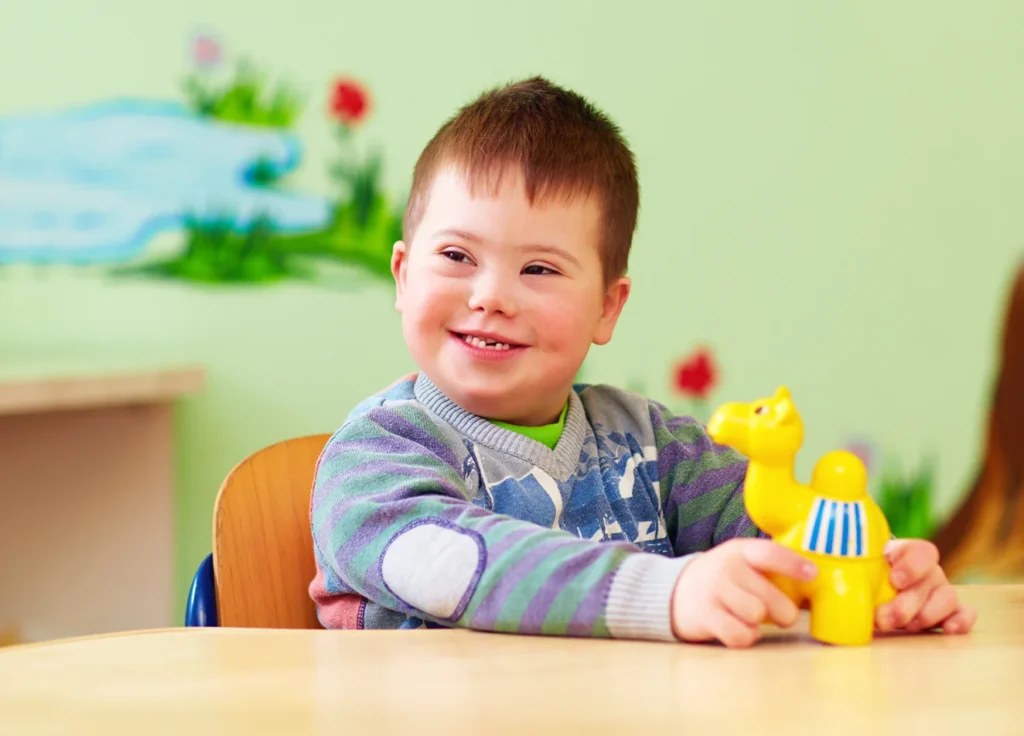
Making Therapy Fun and Meaningful
Children learn best through play. That means you can be creative and keep it fun with activities such as:
- Music, nursery rhymes and rhythm
- Pretend play
- Bubbles, balls, and swings
- Obstacle courses
When Might Physiotherapy Help?
Every child with Down’s syndrome develops differently. If you’re unsure about your child’s movement, concerned that progress has slowed, or would simply like ideas to help them develop the next skill, a specialist children’s physiotherapist can assess how they move and suggest practical activities that fit naturally into family life.
Helen Foale

Highly Specialist Physiotherapist